Alpine Skiing Start Gate
- Degree programme: BSc in Mikro- und Medizintechnik
- Author: Severin Lüdi
- Thesis advisors: Prof. Dr. Bertrand Dutoit, Fabian Bründler
- Expert: Mikael Trigo Da Silva
- Industrial partner: Swiss Timing Ltd. Corgémont
- Year: 2025

In alpine skiing, competitions are decided by hundredths of seconds, making performance optimization crucial. Current start gate systems only provide binary trigger signals without capturing continuous starting dynamics, preventing valuable performance insights. This thesis, conducted with Swiss Timing Ltd., aims to develop an advanced start gate system with continuous measurement capabilities.
System Development
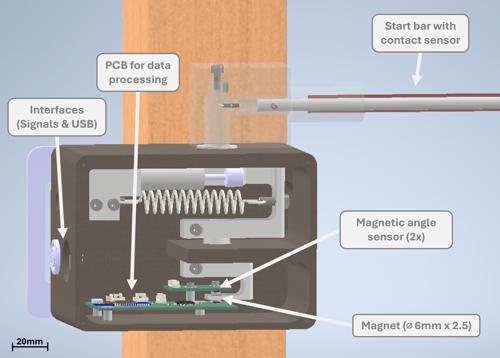
A novel start gate system was developed that transforms traditional mechanical triggers into a comprehensive measurement platform while maintaining core timing functionality (See Fig. 1). The mechanical structure was designed using CAD software and manufactured through 3D printing combined with machining techniques. Two custom PCBs were developed to integrate the sensor electronics into a complete measurement system. (See Fig. 2)
Sensor Technology
The sensing system integrates two redundant absolute magnetic angle sensors sharing a single magnet to ensure system reliability, if one sensor fails, the other maintains full operational capability. A custom PCB integrates both sensors and communicates with a microcontroller via SPI interface, processing sensor data at 20kHz sampling rate with sub-50μs latency throughout the 0° to 90° operational range.
Data Acquisition & Analysis
A visualization tool was developed that operates in two modes: live mode provides real-time data streaming for continuous monitoring, while trigger mode captures complete starting events with full kinematic analysis. A contact sensor (thin film potentiometer) was installed to measure gate arm displacement for calculating transversal components. This enables detailed analysis of athlete start behavior and gate dynamics.
Performance Results
Validation at 1kHz software sampling and trigger velocities (up to 219°/s) demonstrates trigger precision with 99.7% of measurements within +0.243° of the 20° target angle, exceeding the ±2.5° FIS requirement by an order of magnitude. The 20kHz hardware capability enables even higher precision at operational speeds. The contactless architecture provides 14-bit angular resolution while eliminating mechanical wear. Results confirm accurate kinematic calculations, enabling analysis previously impossible with binary trigger systems.
Impact
This development transforms start analysis from data-blind binary triggers to comprehensive performance measurement, providing coaches and athletes with quantitative insights for technique optimization and competitive advantage.